Why Do My Other Teeth Hurt After Wisdom Tooth Extraction
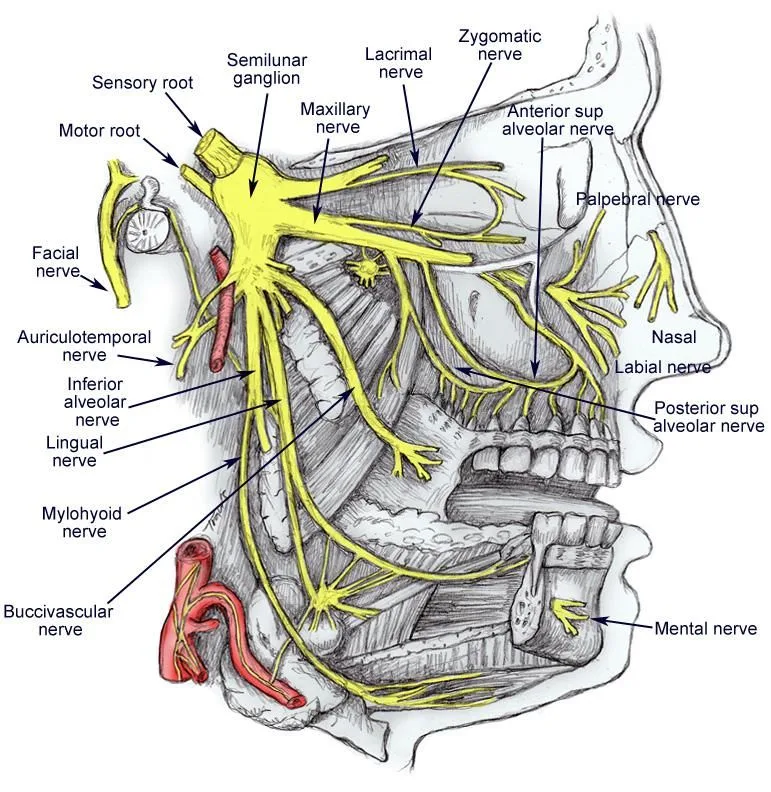
Image source: Bing (Web (fair-use with source credit))
You got your wisdom teeth out expecting relief. Instead, your other teeth start aching. Maybe it's the ones on the opposite side.
Why do my other teeth hurt after wisdom tooth extraction? The answer is usually reassuring: your other teeth are likely fine. The pain is referred pain, a neurological trick where your brain misinterprets signals from one area as coming from another.
A 2022 review in the Journal of Oral and Maxillofacial Surgery found that nearly 40% of patients report some degree of referred dental pain after third molar removal, but less than 2% have actual damage to adjacent teeth.
Quick Answer
Pain in other teeth after wisdom tooth extraction is usually referred pain. Nerves in your jaw share pathways. Healing inflammation irritates nearby nerve branches.
Your brain reads that irritation as pain in healthy teeth. This is normal and fades within a week. Rarely, it signals dry socket, infection, or nerve damage.
Watch for worsening pain after day three.
Why Your Other Teeth Suddenly Hurt After Surgery
Your mouth is wired in a way that doesn't line up with the map in your brain. The nerves serving your wisdom teeth, the inferior alveolar nerve in the lower jaw and the maxillary nerve in the upper jaw, also supply your other molars and premolars. When the surgical site swells, inflammation spreads along the nerve sheath, irritating fibers that lead to your front teeth or even teeth on the opposite side.
This is called referred pain, and it's incredibly common. It follows the same principle as hitting your elbow and feeling your pinky go numb. The trigeminal nerve has three main branches: ophthalmic, maxillary, and mandibular.
Trauma from extraction inflames one branch, and the signal bounces to another, registering as pain in a completely different tooth.
Most patients experience referred pain within the first 48 hours after surgery. It usually feels like a dull, throbbing ache in a few teeth, often on the same side but occasionally on the opposite side too. The key sign?
The aching teeth feel fine when you press on them with a finger or touch them with the tip of your tongue.
The Simple Biology Behind Referred Pain
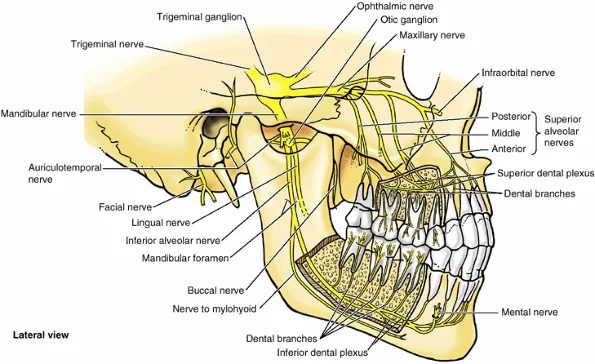
Image source: Bing (Web (fair-use with source credit))
Nerves converge in hubs called trigeminal ganglion, a bundle of nerve cell bodies sitting just inside your skull. Signals from your back teeth, front teeth, and gum tissue all feed into that same hub. When one input line fires hard enough, the hub can't tell which line is the real source.
It sends a generic "pain here" message to your brain, and your brain guesses the location.
That's why a dry socket in the lower left wisdom tooth site can be felt in your left ear, jaw joint, or lower front teeth. Per the American Association of Oral and Maxillofacial Surgeons (AAOMS), referred pain following third molar removal is most commonly felt in the ear, temple, and adjacent teeth. It is almost always the result of normal healing processes.
For most people, referred pain peaks around six to twelve hours after surgery and fades over the next three to four days. If it sticks around beyond day five or gets worse instead of better, that's when you need to pay attention.
The Three Most Common Culprits (and How to Spot Them)
Not all post-extraction tooth pain is referred. Three specific issues can mimic it or cause it directly.
1. Dry socket (alveolar osteitis). This is the number one complication after lower wisdom tooth removal. The blood clot that should protect the bone and nerve endings dislodges or dissolves too early.
You feel a deep, gnawing ache that radiates to your ear, temple, or other teeth. It usually starts on day three or four post-op. The extraction site looks empty and you might have bad breath or a bad taste.
Dry socket happens in about 2% to 5% of lower wisdom tooth extractions, and up to 30% in smokers. If you suspect it, call your surgeon. A medicated dressing usually brings immediate relief.
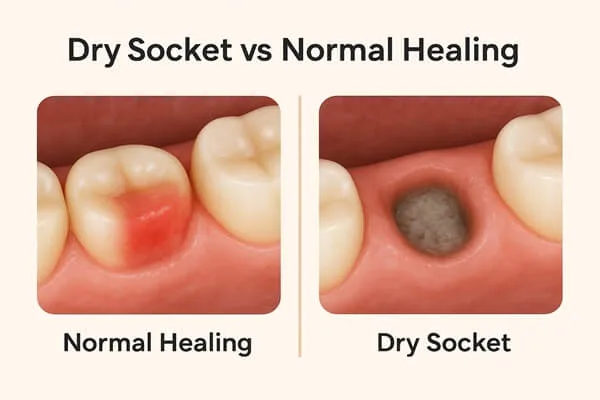
Image source: Bing (Web (fair-use with source credit))
2. Infection (localized osteitis or abscess). Less common but more serious. Signs include persistent, worsening pain after day five, swelling that increases, fever, foul discharge, and pain that keeps you awake at night.
The infection can spread to the root of the adjacent molar, making that tooth feel tender when you bite or tap it. This requires antibiotics or drainage. Never wait it out.
3. Adjacent tooth damage or existing decay. Sometimes the wisdom tooth is so impacted that removing it fractures the second molar. Or a chip in that molar goes unnoticed before surgery.
The pain is sharp and localized to that specific tooth, not a vague ache across several teeth. If pressing on that one tooth hurts badly, see your dentist for an X-ray.
| Symptom | Referred Pain (Normal) | Dry Socket | Infection | Tooth Damage |
|---|---|---|---|---|
| Onset | 6–12 hours post-op | Day 3–4 | Day 5+ | Immediate or delayed |
| Quality | Dull ache, diffuse | Gnawing, deep | Throbbing, constant | Sharp, localized |
| Location | Multiple teeth, opposite side | Ear, temple, jaw | Extraction site + adjacent tooth | One specific tooth |
| Worsens at night? | No | Yes | Yes | Yes |
| Visible socket clot? | Intact | Empty | May be red/white debris | Normal |
When It's a Sign of Something Serious
Call your oral surgeon or dentist right away if you experience any of these red flags:
- Pain that gets worse after day three instead of better
- Fever above 100.4°F
- Swelling that spreads to your eye, cheek, or neck
- Difficulty opening your mouth that worsens
- Numbness or tingling in your lip, chin, or tongue lasting more than 24 hours after anesthesia wears off
- A foul taste or odor that isn't from food debris
- Pus draining from the socket
Nerve injury is rare but possible. The inferior alveolar nerve runs close to the roots of lower wisdom teeth. Temporary paresthesia (numbness/tingling) affects about 0.5% to 5% of lower extractions.
Permanent damage is under 0.1%. If you have numbness in your lower lip or chin after the local anesthetic has worn off, report it immediately. Early intervention can improve recovery outcomes.
Sinus communication is another concern, especially with upper wisdom teeth. The roots can protrude into the maxillary sinus. After removal, a small opening may remain.
This can cause pain in your upper teeth when you lean forward or blow your nose, and a sensation of air moving into the socket. Most small openings heal on their own, but your surgeon needs to know. Your surgeon may recommend avoiding blowing your nose or using a straw for a few weeks.
If the opening is large, a small surgical repair might be needed.
Mistakes That Make the Pain Worse
Mistake 1: Poking or prodding the socket. Every time you disturb the site, you risk dislodging the blood clot. That clot is your body's natural bandage. Lose it too early, and you're looking at dry socket.
Mistake 2: Using a straw or smoking. The suction can pull the clot right out. Smoking delays healing and increases dry socket risk three to four times. The AAOMS recommends avoiding any suction activity for at least a week.
Mistake 3: Skipping prescribed mouth rinses. Your surgeon likely gave you a chlorhexidine rinse or told you to use warm salt water. Food debris trapped in the socket can cause localized infection that radiates pain to other teeth. Gentle rinsing after meals keeps the area clean.
Don't swish vigorously. Let the liquid pool and tilt your head.
Mistake 4: Rinsing or spitting on day one. The first 24 hours are critical. Spitting creates negative pressure that can dislodge the clot. Follow your surgeon's timeline: no rinsing for the first 24 hours, then gentle salt water rinses after that.
Mistake 5: Chewing on the wrong side. Even if you feel fine, your extraction site needs pressure-free healing. Chewing on the opposite side puts extra force on your jaw joint and muscles. That can cause referred muscle pain that feels like tooth pain.
Stick to soft foods for at least three to five days.
Mistake 6: Overusing painkillers to mask symptoms. If pain breaks through your medication schedule, that's worth investigating, not ignoring.
What You Can Do Right Now
Step 1: Ice, ice, ice. For the first 48 hours, apply an ice pack to the outside of your cheek for 20 minutes on, 20 minutes off. This reduces swelling and nerve irritation causing tooth pain. After 48 hours, switch to warm compresses to increase blood flow.
Step 2: Keep your head elevated. Sleep with an extra pillow or two. Gravity helps keep swelling down.
Step 3: Eat soft, cool foods. Cold foods like yogurt or applesauce act as a gentle internal ice pack. Avoid anything hot, crunchy, or spicy for the first few days.
Step 4: Stay on top of your pain schedule. Set an alarm and take your NSAID (ibuprofen) or prescribed painkiller on schedule for the first 48 hours. The American Dental Association typically recommends ibuprofen 400, 600 mg every six hours for the first 48 hours in adults with no contraindications.
Step 5: Distinguish between sites. Gently press on the tooth that hurts. If it feels normal to pressure, it's likely referred pain. If it's tender to tapping, call your dentist.
Step 6: Call your surgeon if things change. A phone call is free. If your pain is getting worse after day three, if you see an empty socket, or if you have any red flags, don't wait. Most oral surgeons keep an after-hours line.
What Recovery Looks Like Beyond Week One
By day seven, most referred pain has faded. Some people notice lingering sensitivity in adjacent teeth for two to three weeks. This is typically normal.
The bone and gum tissue need time to remodel. Your second molar may feel slightly loose or tender when you bite down because the periodontal ligament is still adjusting.
If sensitivity to hot or cold lasts longer than three weeks, it could mean the adjacent tooth has developed reversible pulpitis from the trauma of extraction. That usually resolves on its own. If it persists, your dentist may want to check for micro-cracks or decay.
Most patients are fully comfortable by the four-week mark.
How to Tell the Difference Between Muscle Pain and Tooth Pain
Jaw muscle fatigue is easy to mistake for tooth pain. Your mouth was held open for an hour or more during surgery. Muscle pain feels like a deep ache in your cheek or temple.
It hurts when you open wide or yawn. Tooth pain from referred nerve irritation feels like a dull throb inside the teeth themselves and doesn't change much when you move your jaw.
Try this: gently clench your teeth together. If the pain gets worse, it's more likely muscle or joint related. If the pain stays the same or fades, it's more likely nerve-related referred pain.
Applying a warm compress to the side of your face after 48 hours can help muscle pain. If the compress makes your tooth pain worse, the issue is dental, not muscular.
When to See a Specialist Instead of Your General Dentist
Your oral surgeon is the best person to evaluate post-extraction complications. If referred pain persists beyond two weeks, ask your surgeon for a referral to an endodontist. That's a root canal specialist.
They can test the vitality of your adjacent teeth with cold and electric pulp testing.
If you have numbness in your lip or chin beyond 24 hours, your surgeon may refer you to a neurologist or oral medicine specialist. Nerve injuries need to be mapped and monitored. Keep your surgeon as the primary contact for any extraction-related pain for at least the first month.
The Role of Sinus Pressure in Upper Tooth Pain
If you had an upper wisdom tooth removed, sinus issues can mimic tooth pain for weeks. The roots of upper molars sit very close to the maxillary sinus floor. When the tooth is pulled, the sinus membrane may be exposed.
This causes a dull pressure in your upper back teeth, especially when you bend over or blow your nose. The solution is usually time and nasal decongestants. Avoid blowing your nose forcefully for at least two weeks after surgery.
If pain is accompanied by nasal discharge on one side or a bad taste, you may have a sinus communication. Your surgeon can test this by asking you to puff your cheeks. If air escapes into the socket, that's a confirmatory sign.
Frequently Asked Questions
How long does referred pain last after wisdom tooth extraction?
For most people, referred pain peaks around 6 to 12 hours after surgery and fades within three to five days. If it persists beyond a week, something else is likely going on. Contact your surgeon.
Can wisdom tooth extraction cause pain in front teeth?
Yes. The trigeminal nerve branches that serve your back teeth also supply your front teeth. Inflammation near the extraction site can irritate those nerve pathways, causing dull or throbbing pain in your incisors or canines.
Is it normal for teeth on the opposite side to hurt after extraction?
It is. Referred pain doesn't respect the midline. Nerve signals can cross from one side of the jaw to the other through the trigeminal ganglion.
Up to 15% of patients report contralateral pain in the first few days post-op.
When should I worry about pain in other teeth after extraction?
Worry if the pain gets worse after day three, if it's sharp and localized to one tooth, if you have a fever, or if the extraction site looks empty and painful. Those point toward dry socket, infection, or tooth damage.
Can I take ibuprofen for referred tooth pain after extraction?
Yes. Ibuprofen is the first-line recommendation for post-extraction pain. It reduces inflammation at the nerve level, which directly addresses the cause of referred pain.
Acetaminophen can be added for extra relief. Always follow your surgeon's dosing instructions.
Does referred pain mean my teeth are damaged?
No. In the vast majority of cases, referred pain means your nerves are irritated by swelling, not that your teeth are cracked or decayed. If direct pressure on the tooth doesn't hurt, it's almost certainly referred pain.
When can I go back to normal eating after wisdom tooth removal?
Most people transition to soft solid foods by day three or four. Full normal chewing usually resumes around day seven to ten, depending on the complexity of the extraction. Listen to your body.

Similar Posts