Samsung Water Filter Replacements
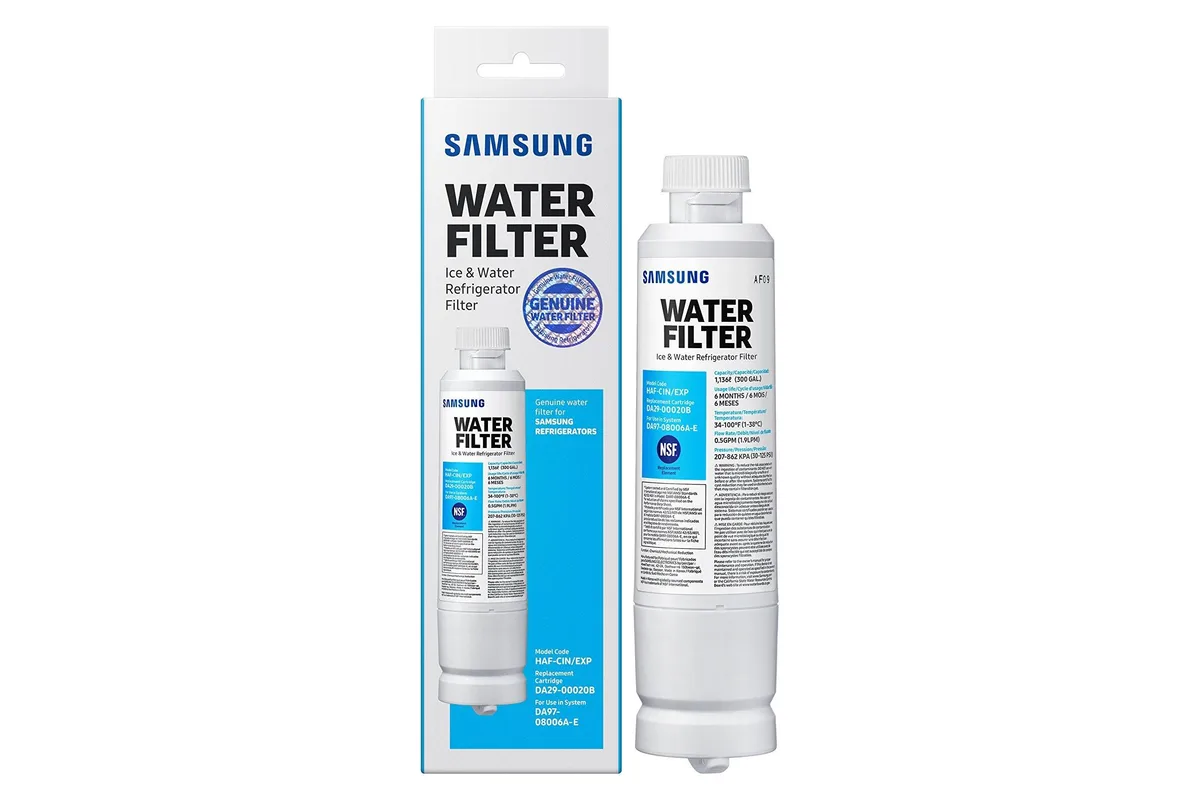
You've probably stood in front of your Samsung fridge, glass in hand, watching that "Replace Filter" light blink at you for the third day in a row. You know you need Samsung water filter replacements, but when you start looking online, the options are confusing. DA29-00020B.
HAF-CIN. Internal versus external. OEM versus compatible.
It feels like you need a decoder ring just to buy a simple filter.
Here's the straightforward truth. As of 2026, Samsung refrigerators use two distinct filter families. The only thing that determines which one you need is your refrigerator's model number.
That 10-character code on a sticker inside your fridge is the key to everything. Once you know it, the rest of the process takes about five minutes and requires no tools. Per NSF/ANSI standard certifications, a properly installed filter removes 97% of chlorine taste and odor, plus significant levels of lead, cysts, and sediment.
Let's walk through exactly how to get there.
Image source: Bing (Web (fair-use with source credit))
Quick Answer
Your Samsung fridge needs one specific filter family. Look for your model number inside the fresh food compartment. That code tells you which filter fits.
The two families are DA29-series and HAF-series. They are not interchangeable. Price ranges from $15 to $70 depending on brand.
Installation takes under five minutes with no tools. Replace every six months.
How to Find Your Fridge Model Number (The Only Step That Matters)
Every decision about Samsung water filter replacements starts with one piece of information: the refrigerator's model number. Without it, you are guessing. With it, you have an exact answer in about thirty seconds.
Where to look. Open your refrigerator's fresh food door, not the freezer. Look on the left interior wall. You will see a white or silver sticker with a barcode, a serial number, and a model number.
The model number typically starts with "RF" for most Samsung French door and side-by-side refrigerators. It looks something like RF23A9071SR or RF28R7201SR.
What if the sticker is damaged or missing? This happens more often than you would expect. If the sticker is worn away or someone peeled it off during a cleaning, check the top or bottom of the door frame. Some models place a secondary label on the ceiling of the refrigerator compartment or behind the crisper drawer.
As a last resort, register or log into your Samsung account on the official Samsung support website and look under "My Products" if you registered the appliance when you bought it.
Why this matters so much. The model number tells you three critical things: which filter family your fridge uses, where the filter is located, and what the correct dimensions and thread type are. The DA29-00020B filter and the HAF-CIN filter look similar at a glance. They are not the same size.
They are not interchangeable. Cramming the wrong one into the housing can crack the plastic and cause a slow leak behind your fridge that damages your flooring. Aggregate buyer reviews describe this scenario hundreds of times.
External vs. Internal Filters: Your First Decision Branch
Samsung refrigerators place their water filters in one of two locations. This is the first fork in your decision tree. The location determines which physical filter design you need and how you install it.
Internal filters. These live inside the fresh food compartment. You access them by opening the refrigerator door and looking in the upper right or upper left corner of the interior ceiling. Some models hide the filter behind a small rectangular cover that snaps off.
Internal filters are cylindrical and twist-lock into place. They are slightly longer and narrower than their external counterparts. You will find internal filters on newer Samsung French door models and many of the Bespoke series refrigerators released after 2020.
The most common internal filter model is the HAF-CIN or HAF-QIN.
External filters. These sit behind the base grille at the bottom front of the refrigerator. You have to kneel down and pull the grille off to access them. External filters are shorter and wider.
They use a push-and-twist mechanism with a distinct cap shape. You will find external filters on many Samsung side-by-side refrigerators and older French door models. The most common external filter model is the DA29-00020B or DA29-00019B.
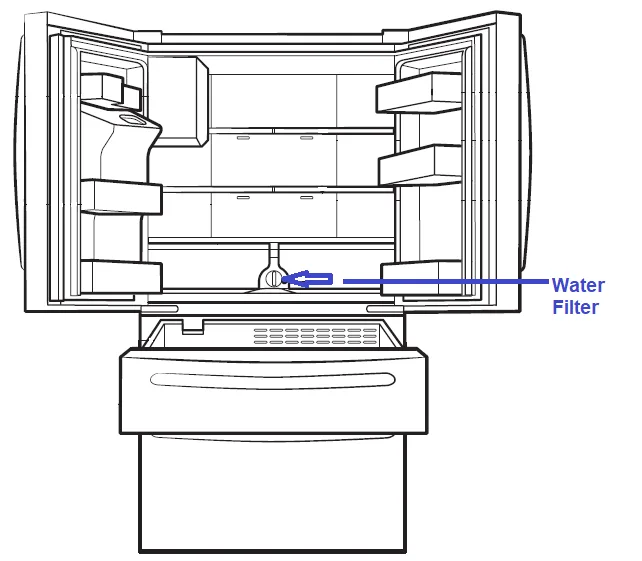
Image source: Bing (Web (fair-use with source credit))
How to tell which one you have without looking. Refer back to that model number. Samsung's documentation groups filter types by model prefix. If your model number begins with RF23, RF24, RF26, or RF28, there is a good chance you have an internal filter.
Models beginning with RS, RB, or older RF numbers more often use external filters. But do not trust the prefix alone. Open the door first.
If you see a filter housing or a small square cover on the ceiling of the fresh food section, you have an internal filter. If you see nothing, the filter is behind the base grille.
Why you cannot mix them. Internal and external filters have different thread pitches, different diameters, and different O-ring sizes. An external filter will not seal in an internal housing. An internal filter is too long to fit behind the base grille.
Do not force either one. Forcing it breaks the plastic housing and creates a leak path.
OEM vs. Compatible Filters: What You Sacrifice vs. What You Save
Once you know which filter family your fridge takes, you face a second decision. Do you buy an OEM filter from Samsung, or do you buy a certified compatible filter from a third-party manufacturer?
This is a real trade-off. It is not a simple case of "OEM is a rip-off and compatible is just as good." It is also not true that "you must always buy OEM or your fridge will explode." The honest answer depends on your budget, your water quality, and how long you plan to keep the refrigerator.
OEM Samsung filters. These run $45 to $70 each. They come in Samsung-branded packaging with the Samsung part number clearly printed on the box. OEM filters are manufactured to Samsung's exact specifications.
They are NSF/ANSI 42 and 53 certified specifically for the contaminant reduction claims Samsung advertises for each model. Buying OEM preserves your refrigerator warranty. This matters if your fridge is still within its first year or if you purchased an extended warranty through Samsung directly.
Certified compatible filters. These run $15 to $35 each. They are made by companies that manufacture filters to fit Samsung housings. The best compatible filters carry their own NSF/ANSI 42 and 53 certifications, independently tested by NSF International.
The critical phrase to look for on the packaging is "NSF/ANSI 42" and "NSF/ANSI 53." If those certifications are present and the filter is listed in the NSF certification database, the filter meets the same contaminant reduction standards as OEM. If those certifications are absent, do not buy it.
Where compatible filters fall short. Aggregate user reviews and manufacturer specifications indicate three common issues with lower-end compatible filters. First, flow rate can be slower. Some compatible filters use denser carbon media that restricts water pressure.
Second, the O-ring included with cheaper filters is sometimes lower quality and can fail within a few months, causing a slow drip at the connection point. Third, some compatible filters do not sync properly with the fridge's electronic filter timer, so the "Replace Filter" light may stay on even after you install a new filter.
The honest recommendation. If your fridge is under warranty, buy OEM. It removes all risk and keeps your warranty intact. If your fridge is out of warranty and you want to save money, buy a certified compatible filter.
Spend the extra few dollars to get one that explicitly lists NSF/ANSI 42 and 53 certification on the box. The $8 unbranded filter from a random seller is not a bargain when it leaks water across your kitchen floor at 3 AM.
Step-by-Step Installation Guide (Both Types)
You have the right filter. Now you need to get it into the fridge without making a mess.
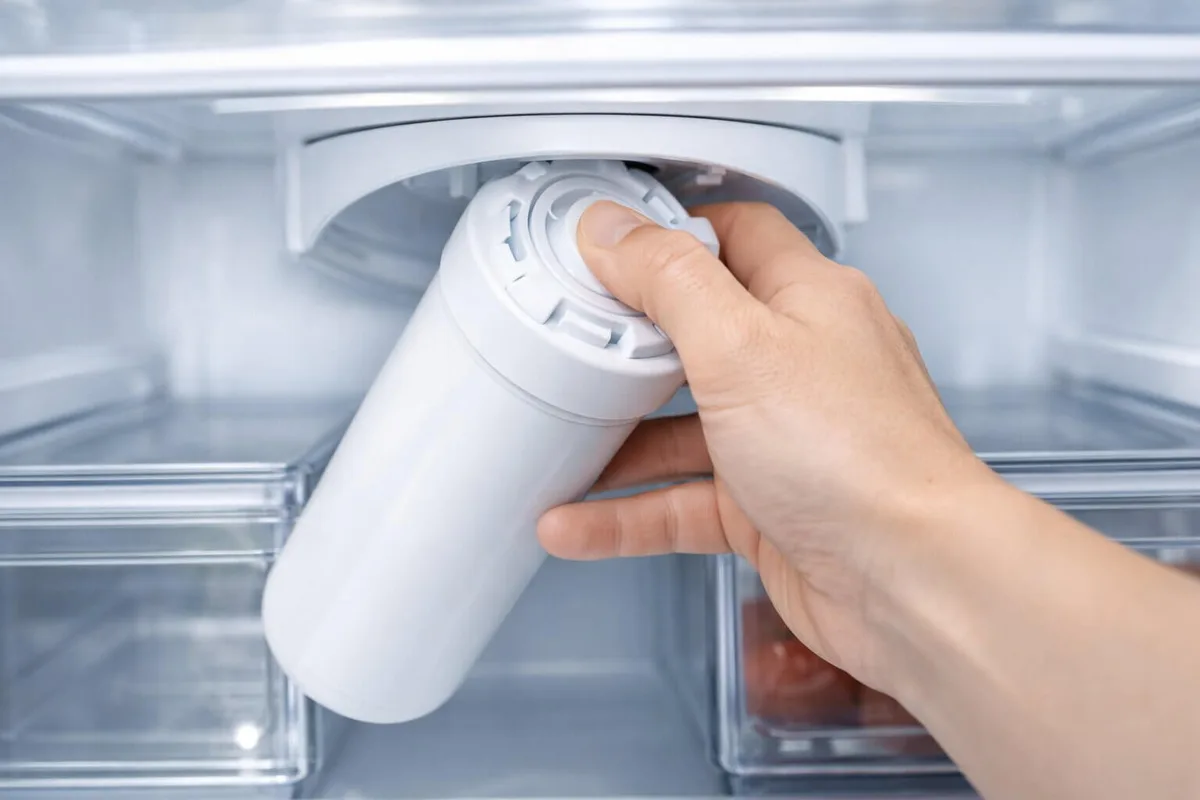
Image source: Bing (Web (fair-use with source credit))
For internal filters (HAF-CIN or HAF-QIN).
- Open the fresh food door. Locate the filter in the upper right or upper left ceiling area.
- If there is a small rectangular cover, pinch the tabs and pull it straight off.
- Grasp the old filter and twist it counterclockwise about a quarter turn. It will stop and release. Pull it straight down.
- Unwrap the new filter. Remove the plastic cap and the rubber O-ring protector if present.
- Line up the tabs on the new filter with the slots in the housing. Push up firmly and twist clockwise until it locks. You will feel a firm stop.
- Run 2 to 3 gallons of water through the dispenser to flush the new carbon media. The water will look cloudy or have black specks at first. This is normal. Do not drink the first few glasses.
- Reset the filter indicator light. On most Samsung models, press and hold the "Ice Type" and "Fridge" buttons simultaneously for three seconds until the light turns off. Some newer models use a "Filter Reset" button in the settings menu.
For external filters (DA29-00020B or DA29-00019B).
- Locate the base grille at the bottom front of the refrigerator. Pull it straight toward you. It snaps off. No tools needed.
- Find the filter housing. On most models, it is on the left side behind the grille.
- Press the small button or tab on the housing and pull the old filter straight out. Some models require a quarter turn counterclockwise first.
- Insert the new filter into the housing. Push firmly until you hear it click or snap into place.
- Push the base grille back onto the fridge. It snaps back on.
- Run 2 to 3 gallons of water through the dispenser to flush the system.
- Reset the filter indicator light using the same button sequence described above.
Important notes. Always keep the water dispenser running continuously while flushing. Do not dispense a glass, wait, then dispense another. Let it run in a steady stream.
This ensures the carbon fines are fully flushed out. If you see a slow drip after installation, the O-ring is not seated correctly. Remove the filter, check the O-ring for damage, lubricate it with a drop of water, and reinstall.
A persistent drip means the O-ring is compromised and needs replacement.
Mistakes That Cost You Money or Water Damage
People make the same errors over and over. Avoid these five and you will save time, money, and a potential mess.
Buying the wrong filter family. This is the most common mistake. Someone sees "fits Samsung" on a generic box and assumes it will work. It will not.
The DA29 and HAF families are physically different. Always confirm your model number before buying.
Forgetting to flush the new filter. Carbon dust from manufacturing collects inside new filters. If you skip the 2 to 3 gallon flush, that black dust ends up in your drinking glass. It is harmless but unpleasant.
More importantly, an unflushed filter can clog your ice maker's water line with carbon fines.
Cross-threading the internal filter. These filters need to seat perfectly. If you twist at an angle, the threads can strip. Once stripped, the housing needs replacement.
Go slow. If you feel resistance right away, stop and realign.
Leaving the old O-ring in place. When you install a new external filter, the old O-ring sometimes sticks inside the housing. If you push the new filter in on top of it, you get two O-rings stacked. This prevents a proper seal and causes a slow leak.
Check inside the housing before inserting the new filter.
Ignoring the 6 month schedule. Many users wait until the water tastes bad or the flow slows to a trickle. By that point, the filter is fully saturated and may be releasing trapped contaminants back into the water. Set a calendar reminder.
The NSF standard recommends replacement at 6 months or 300 gallons, whichever comes first.
When to Change It Early (And When You Can Stretch It)
The 6 month rule is a guideline, not a hard law. Your actual replacement schedule depends on your water quality and usage.
Change it early if. You notice a muddy or metallic taste in the water. The flow rate from the dispenser drops noticeably. Your ice cubes look cloudy or have an odor.
Your household runs through more than 50 gallons of dispensed water per month. You have well water with high sediment content. In these cases, replace at 4 to 5 months instead of 6.
You can stretch it if. You are a single person or couple using the fridge water sparingly. You are on municipal water with good quality. The flow rate remains strong at month six.
The water still tastes clean. In these cases, stretching to 7 or 8 months is reasonable. Do not go past 9 months.
The carbon media becomes saturated and can no longer trap contaminants effectively.
One hard rule. Do not stretch a filter that has been in the fridge for a year, regardless of usage. Bacteria can grow on the saturated carbon media over time. The filter becomes a breeding ground rather than a purification device.
Replace annually at minimum, even if you barely use the dispenser.
Frequently Asked Questions
How do I reset the filter light on my Samsung refrigerator?
Press and hold the "Ice Type" and "Fridge" buttons simultaneously for three seconds. The light will turn off. On some newer models, navigate to the settings menu on the display panel and select "Filter Reset." The exact button combination varies slightly by model year, but this method works for most.
Can I use any brand of replacement filter in my Samsung fridge?
Only use filters designed for your specific filter family. DA29-series fridges require DA29 filters. HAF-series fridges require HAF filters.
Within those families, certified compatible brands work well. Unbranded or uncertified filters carry risk of poor fit, slow flow, and leaks.
Why is my water pressure slow after installing a new filter?
New filters have dense carbon media that restricts flow slightly for the first few gallons. This is normal. Run 2 to 3 gallons through the dispenser to flush the filter and the pressure should improve.
If it remains slow, you may have an air pocket in the line or a clogged filter.
Does using a non-OEM filter void my Samsung warranty?
No. Under the Magnuson-Moss Warranty Act, a manufacturer cannot require you to use its brand of replacement parts unless it provides those parts for free. Using a certified compatible filter does not void your warranty.
However, if a non-OEM filter causes damage, Samsung may deny coverage for that specific repair.
How do I know if my filter is working correctly?
The most reliable test is the water taste and appearance. If the water tastes clean and clear, the filter is working. If you notice a chlorine taste, a muddy flavor, or visible sediment, it is time to replace.
Some filter housings have a date sticker. Write the installation date on it for reference.

Similar Posts